
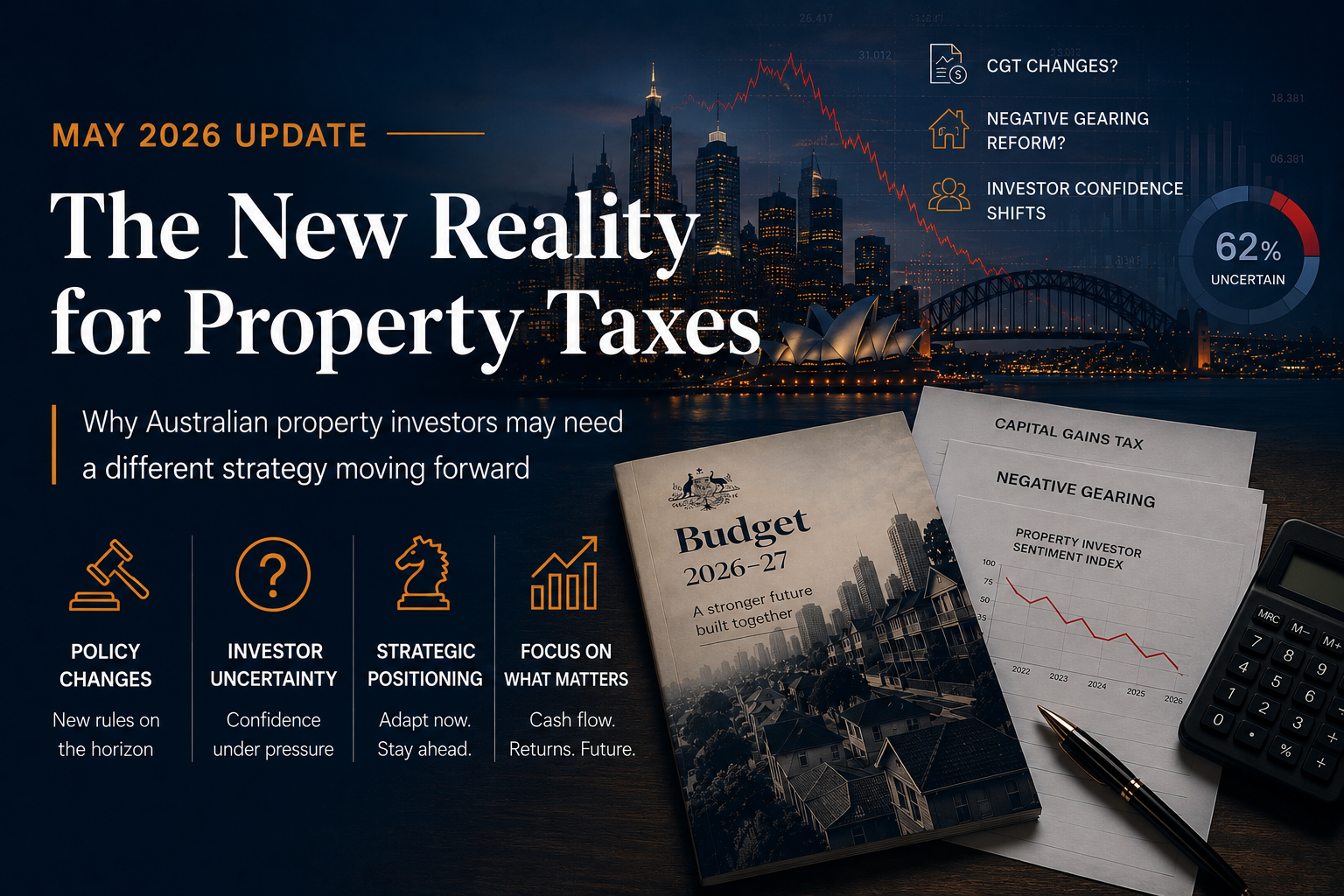
"Australia’s property market may be approaching one of its most significant structural shifts in decades."
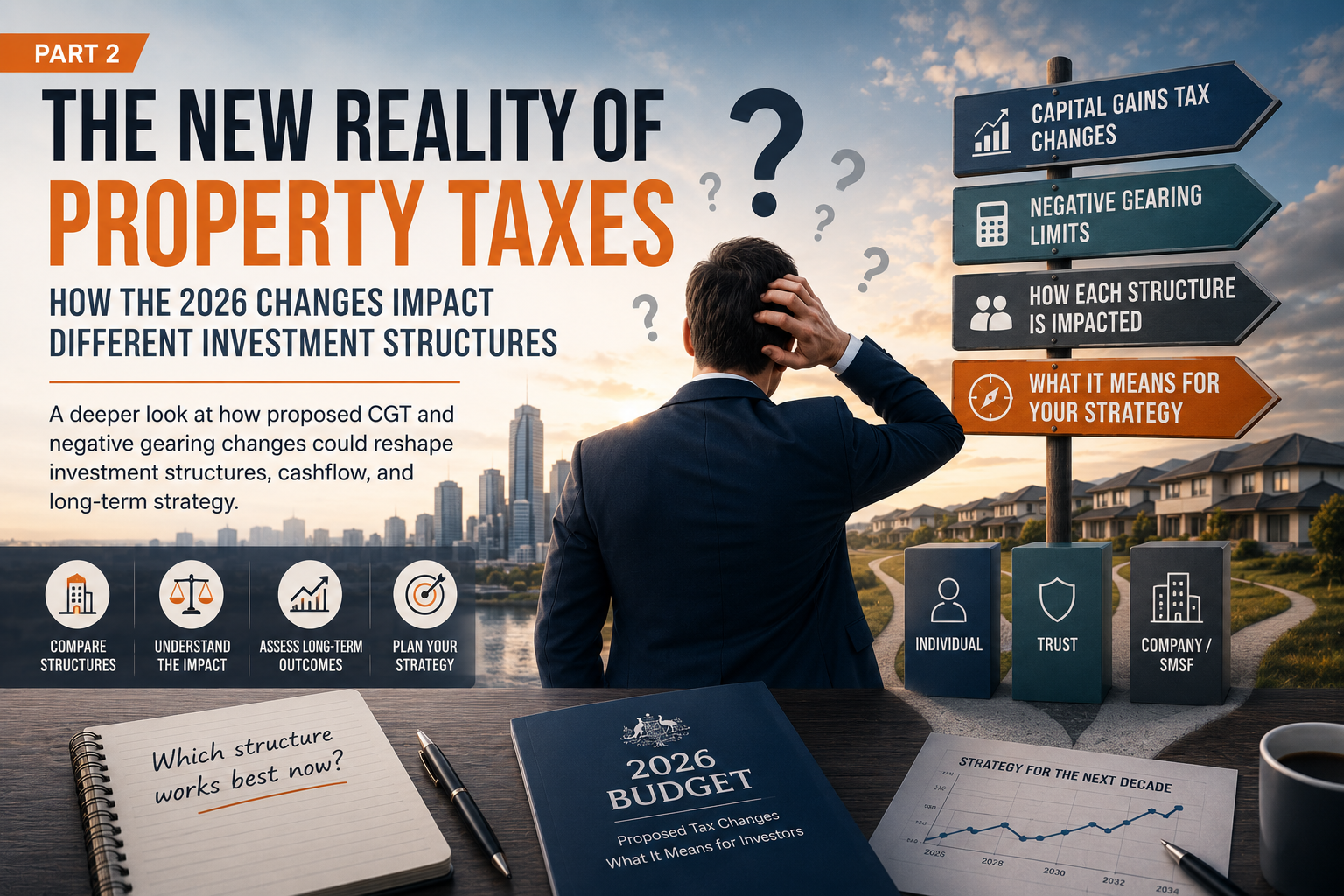
Ongoing discussions around changes to capital gains tax (CGT) and negative gearing have moved from political talking points into serious policy consideration. While the final form of these reforms remains uncertain, the direction is becoming clearer—future incentives may be reduced, and the way property investments are taxed could change meaningfully.
This is not simply a policy update—it has the potential to reshape how investors assess risk, structure portfolios, and select assets moving forward.
The Proposed "New Rules" at a Glance
While no final legislation has been passed, current proposals and industry discussions point toward several potential changes investors should be aware of:
- Reduction in CGT discount: The current 50% capital gains tax discount for assets held over 12 months may be reduced (potentially to 25%), increasing the effective tax payable on sale.
- Negative gearing restrictions: Tax benefits may be limited to newly built properties, meaning investors purchasing established properties may no longer be able to offset losses against their income.
- Reintroduction of indexation: Capital gains could be adjusted for inflation before tax is applied, potentially favouring longer-term holding strategies.
- Grandfathering of existing assets: Properties purchased before any policy changes may retain current tax benefits, creating a distinction between existing and future investments.
While the exact structure and timing of these reforms are still evolving, the broader direction is clear: future investment outcomes may depend less on tax advantages and more on the underlying performance of the asset.
What this means for Investors?
The next property cycle may look very different from the last.
Beyond the individual policy changes, a broader structural shift may be emerging. The market could gradually move away from being heavily incentive-driven and back toward fundamentals-led investing, where asset quality, location, and long-term demand play a much larger role in determining outcomes.
In this environment, investors may need to reassess how they evaluate opportunities and build their portfolios. The following shifts are likely to shape how the next phase of the market evolves:
- Scarcity and Land Value May Become More Important
In changing policy environments, quality assets tend to stand out more clearly. Properties supported by strong underlying land value, limited future supply, and genuine owner-occupier demand are often better positioned to maintain long-term appeal through market cycles. As speculative demand weakens, the gap between investment-grade assets and average properties may widen further, placing greater importance on selecting locations with real scarcity and sustainable demand drivers.
- Oversupply Risk Could Increase in Some Segments
If future incentives heavily favour newly built dwellings, parts of the market may experience increased supply pressure. Not all new developments perform equally, particularly in locations where large volumes of similar stock continue entering the market. This is where investors need to separate short-term incentives from long-term fundamentals. Strong investment decisions are rarely driven by tax benefits alone. They are driven by demand, scarcity, location quality, and long-term economic drivers.
- Cashflow Strength May Matter More Than Tax Benefits
One of the biggest mindset shifts may be the move away from relying on tax savings to justify underperforming assets. Instead, investors may increasingly focus on whether a property can perform on its own merits through stronger rental demand, sustainable holding costs, lower vacancy risk, and long-term income resilience. This may lead to greater emphasis on balanced portfolios that combine both growth potential and cashflow stability rather than chasing purely tax-driven strategies.
- Diversification Could Become a Key Risk Management Strategy
The next cycle is unlikely to produce uniform performance across all cities, suburbs, and asset types. Some markets may benefit from affordability migration and infrastructure investment, while others may struggle with supply pressure or weaker economic conditions. As a result, diversification across locations and asset profiles may become increasingly important in managing both market and policy risk.
- Structuring and Long-Term Planning Become Critical
As taxation rules evolve, ownership structures and long-term planning may play a larger role in investment outcomes. Borrowing capacity, ownership entities, succession planning, asset protection, and tax efficiency are no longer side considerations — they become central components of portfolio strategy. Investors who think beyond the next purchase and build with long-term flexibility in mind are likely to be better positioned as the environment changes.
- Long-Term Investing May Be Rewarded Again
If indexation replaces or partially replaces the current CGT discount model, it could encourage a return to longer holding periods and more disciplined investing. Rather than short-term speculation, the focus may shift back toward strategic portfolio building, compounding growth, and intergenerational wealth creation built around high-quality assets held through multiple cycles.
- Market Selection Will Matter More Than Ever
Not all markets will respond equally to these changes, and the gap between high-performing, investment-grade assets and average properties may widen further. Outcomes will increasingly depend on selecting locations supported by infrastructure investment, population growth, affordability migration, supply constraints, and strong rental demand. This may also lead to a widening divide between strategic investors and reactive investors, where those focused on fundamentals are better positioned to outperform.
How InvestorPro helps clients navigate this shift
At InvestorPro, our approach has never been built around chasing incentives or short-term market hype.
We focus on identifying investment-grade opportunities backed by strong fundamentals - scarcity, infrastructure growth, supply-demand imbalance, and genuine owner-occupier appeal. As market conditions evolve, this disciplined approach becomes even more critical.
As reliance on tax-driven outcomes reduces, long-term performance will be driven by asset quality and market selection. Over the next decade, the investors who perform best may not be the fastest—but the most strategic.
We help clients build resilient portfolios through clear strategy, disciplined asset selection, and diversification across markets. In a changing market, strategy becomes the most valuable asset.
Want to audit your strategy before the new financial year? Book a free discovery call today to ensure your portfolio is built to handle the 2026 changes.